
Table of Contents
- What Are AI Shopping Agents?
- Why AI Shopping Agents Matter for Ecommerce in 2026
- How Do AI Shopping Agents Work?
- Traditional Ecommerce vs. AI Shopping Agents
- How Shopify Is Supporting Agentic Commerce
- Is Your Shopify Store Ready for AI Shopping Agents?
- The Role of SEO in AI Shopping
- Industry Examples: How AI Shopping Could Influence Buying Decisions
- Common Mistakes Shopify Merchants Should Avoid
- How to Measure AI Shopping Performance
- A Practical 30-Day Shopify AI Shopping Readiness Plan
- Frequently Asked Questions About AI Shopping Agents
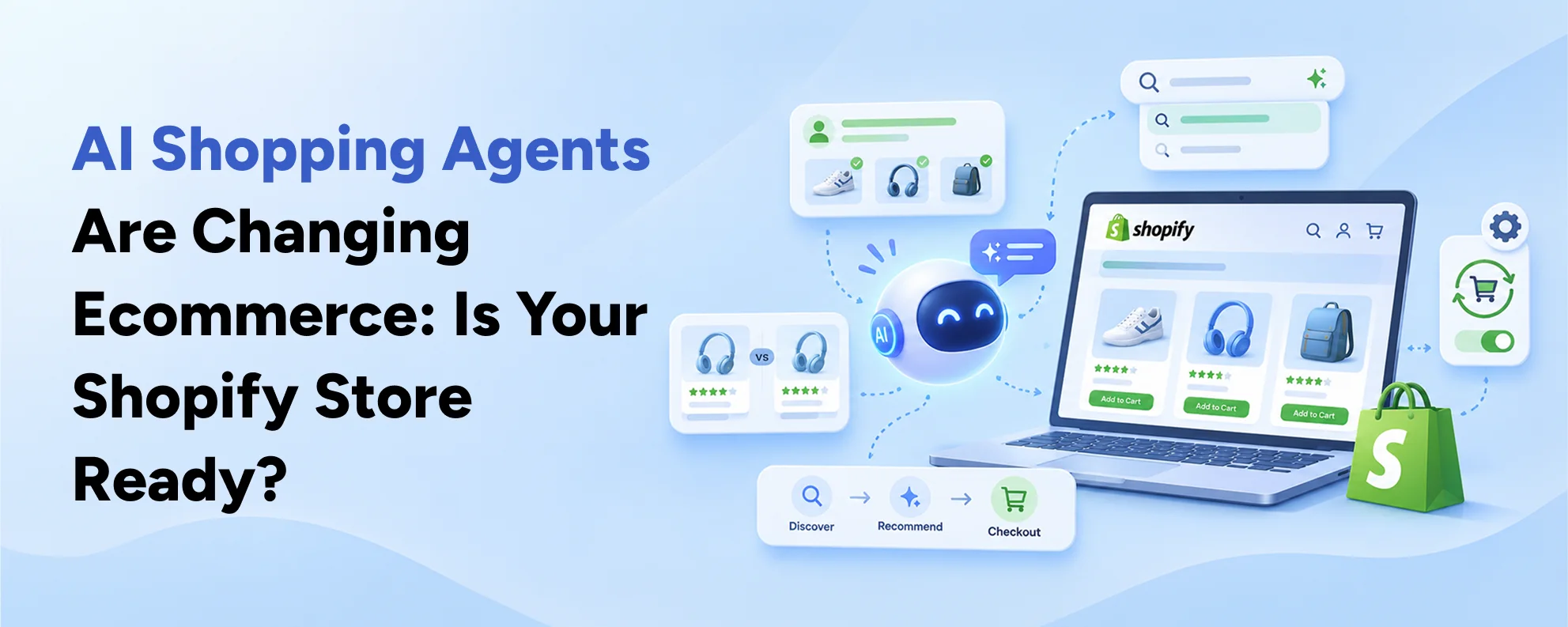
AI shopping agents are transforming how customers discover, compare, and purchase products online. Instead of visiting multiple ecommerce websites, shoppers can now ask an AI assistant to find products that match their exact requirements, compare available options, and guide them toward checkout.
Imagine someone searching for a waterproof travel backpack under $100 that fits airline cabin requirements. Traditionally, that customer might browse Google, open several stores, inspect product specifications, and compare reviews.
Today, an AI shopping assistant can help perform much of that research in one conversation.
For Shopify merchants, this shift creates a significant opportunity. However, it also introduces a new challenge: your products need to be understandable not only to human shoppers and search engines but also to AI-powered discovery systems.
Shopify has already introduced infrastructure that helps eligible merchants reach customers through conversational AI channels. Meanwhile, Google and OpenAI continue developing ways to connect product discovery with ecommerce transactions.
So, what does this mean for your business?
In this guide, we'll examine how AI shopping agents work, what Shopify already supports, and the practical steps ecommerce brands should take to improve their readiness for agentic commerce.
What Are AI Shopping Agents?
AI shopping agents are artificial intelligence systems that help customers research products, evaluate alternatives, and complete shopping-related tasks.
Unlike traditional ecommerce search tools, AI agents can interpret detailed requests, consider multiple product attributes, and respond to follow-up questions.
For example, a customer might ask:
"Find a lightweight winter jacket for women, suitable for temperatures around 5°C, available in medium, and costing less than $150."
An AI shopping agent may evaluate product descriptions, available sizes, pricing, materials, reviews, and shipping details before recommending suitable items.
This process is often called agentic commerce.
AI Shopping Assistants vs. AI Shopping Agents
Although these terms overlap, they describe different levels of capability.
An AI shopping assistant primarily provides information and recommendations. An agent can go further by interacting with available tools, checking inventory, preparing a cart, or initiating an authorized checkout process.
Nevertheless, autonomy varies by platform. Some shopping experiences support product discovery only, while others offer transactional capabilities.
Importantly, customers should remain in control of purchase approvals, payment authorization, and sensitive information.
What Makes AI Shopping Different?
Three capabilities distinguish AI-assisted shopping from conventional ecommerce browsing.
First, AI can interpret natural-language requests instead of relying entirely on exact search keywords.
Second, it can compare products across multiple attributes, such as budget, fit, compatibility, delivery time, and customer preferences.
Third, where supported, AI shopping tools can connect discovery with commerce functions such as cart creation and checkout.
Consequently, a clear, accurate product catalog becomes essential to ecommerce discoverability.
Why AI Shopping Agents Matter for Ecommerce in 2026
AI-assisted shopping is moving beyond experimentation.
According to Shopify's Q1 2026 commerce analysis, referral sessions from AI chatbots grew more than eightfold year over year. Orders attributed to AI-powered search increased nearly thirteenfold during the same period.
Additionally, Shopify reported that AI-referred product-page sessions converted at nearly 50% higher rates than comparable organic search sessions, while AI-attributed orders carried a 14% higher average order value.
These findings are significant because they suggest that some AI-referred shoppers arrive with more specific purchase intentions.
However, the figures describe Shopify's observed platform data, not a guaranteed result for every merchant. Furthermore, traditional organic search continues to deliver substantially more total traffic than tracked AI referrals.
AI Search Is Compressing the Buying Journey
Consider the traditional purchase process:
- Search for a product category.
- Open multiple websites.
- Compare specifications and pricing.
- Read customer reviews.
- Check availability and shipping.
- Choose a store and complete checkout.
AI-assisted commerce can combine several of these research activities into a shorter conversation.
As a result, customers may reach product pages after making more informed decisions.
Smaller Brands Can Compete Through Product Relevance
AI shopping also introduces opportunities for specialized ecommerce brands.
For instance, a smaller fashion retailer may offer a product that closely matches a shopper's requested fabric, size, price, and style.
A well-structured catalog can help a shopping system understand that relevance.
However, AI recommendations are not guaranteed, and individual platforms determine their own product selection and ranking criteria.
The practical opportunity is to make your products eligible, accurate, detailed, and easy to evaluate.
How Do AI Shopping Agents Work?
Although each platform uses different technology, AI shopping generally involves four connected stages.
Step 1: Understanding Customer Intent
The shopper describes a product requirement through a conversational interface.
The request might include preferred materials, price limits, product dimensions, availability, or specific delivery requirements.
For example:
"I need a vegan leather laptop bag for a 15-inch laptop, with a shoulder strap, under $90."
The AI system interprets these requirements to determine which product attributes matter.
Step 2: Discovering Relevant Products
Next, the shopping system retrieves product information from available data sources.
Depending on the platform, these may include:
- Shopify Catalog.
- Google Merchant Center feeds.
- Merchant product feeds.
- Search-indexed product pages.
- Approved commerce APIs.
- Other accessible product information.
Therefore, accurate titles, descriptions, product attributes, and prices are essential.
Step 3: Comparing Products
The AI shopping system evaluates products based on their relevance to the request.
For example, a product may match the customer's budget but fail to meet the required dimensions.
Another product might be technically compatible but unavailable in the requested size.
Consequently, merchants that publish complete product details make accurate comparisons easier.
Step 4: Checkout and Order Processing
Once the customer selects a product, the purchase proceeds through the supported checkout experience.
Some AI channels can offer direct or embedded checkout for eligible merchants. Others direct customers to the merchant's own online store.
The final transaction still requires the applicable purchase authorization, payment processing, and fulfillment controls.
The important distinction is that AI shopping does not eliminate the need for reliable ecommerce operations. Rather, it connects customer discovery with existing commerce infrastructure.
Traditional Ecommerce vs. AI Shopping Agents
| Feature | Traditional Ecommerce | AI-Assisted Ecommerce |
|---|---|---|
| Product discovery | Search engines, navigation, filters | Conversational prompts and product recommendations |
| Product comparison | Shoppers manually compare listings | AI helps compare selected attributes |
| Personalization | Browsing behavior and predefined rules | Conversational preferences and available customer context |
| Product information | Product pages and search snippets | Structured catalogs, feeds, APIs, and indexed content |
| Checkout | Usually merchant-owned website | Merchant checkout or supported embedded checkout |
| Merchant priority | SEO, UX, merchandising, advertising | Existing fundamentals plus AI-ready product information |
| Customer control | Shoppers select and purchase products | Shoppers approve purchases and permissions as required |
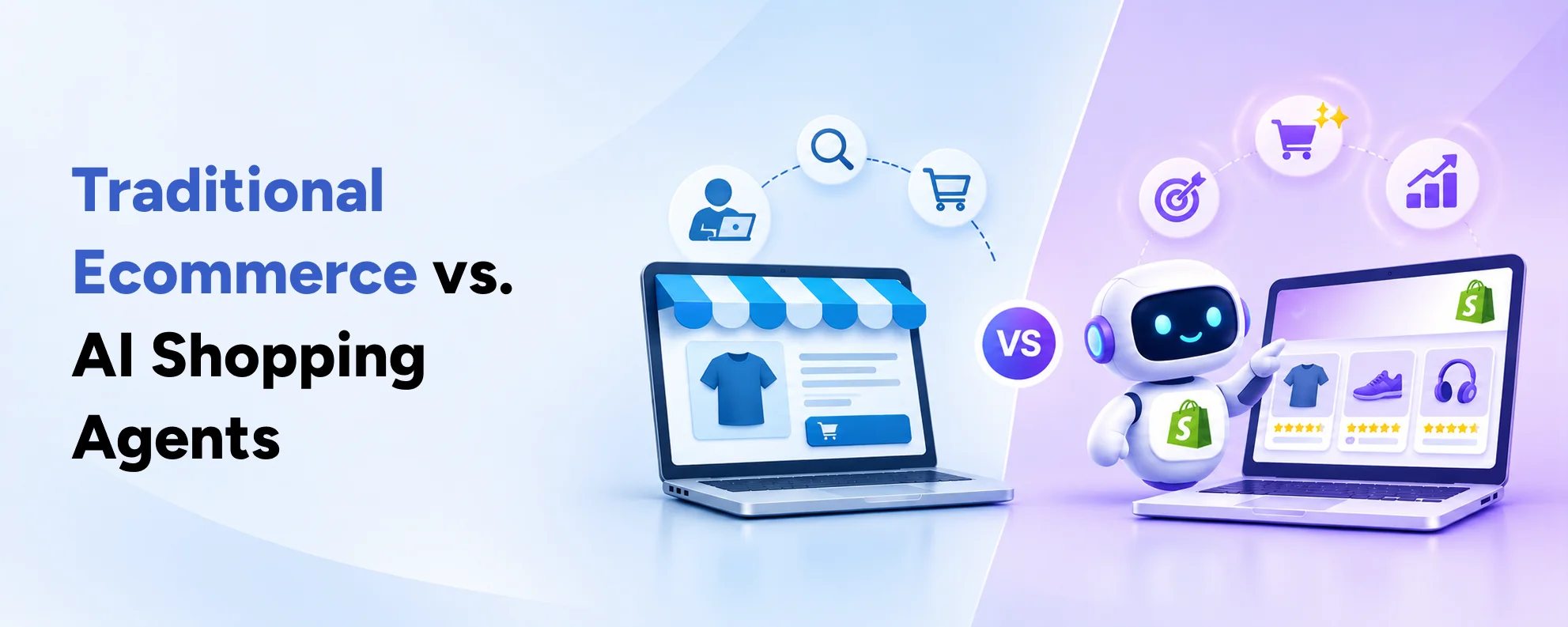
AI shopping is not replacing every existing ecommerce channel. Instead, it is becoming another way customers interact with product information.
For merchants, the most practical strategy is to optimize both the traditional storefront and emerging AI discovery channels.
How Shopify Is Supporting Agentic Commerce
Shopify is building commerce infrastructure that connects product discovery with AI-powered shopping experiences.
Its 2026 platform developments include Shopify Catalog, Agentic Storefronts, commerce APIs, and additional tools for developers.
Shopify Catalog
Shopify Catalog provides structured product information that participating shopping services can use to understand eligible products.
This information may include product titles, descriptions, images, prices, options, and availability.
For eligible Shopify stores, product inclusion in Shopify Catalog is automatic.
However, this does not guarantee visibility in a particular AI answer or product recommendation.
Therefore, merchants should treat catalog eligibility as a starting point rather than a completed marketing strategy.
Shopify Agentic Storefronts
Shopify Agentic Storefronts allow eligible merchants to make products available across supported AI shopping channels.
These include experiences connected to ChatGPT, Microsoft Copilot, Google AI Mode, and other platforms, subject to channel requirements.
Merchants can review their settings in Shopify Admin under Sales channels > Agentic.
Importantly, eligibility depends on factors such as store status, product data, policies, selling regions, and individual channel requirements.
ChatGPT Shopping and Product Discovery
OpenAI expanded its product discovery capabilities in March 2026, helping customers explore and compare products within conversational shopping experiences.
According to OpenAI's product discovery announcement, Shopify Catalog provides product information for relevant shopping conversations.
For the standard ChatGPT shopping experience, buyers complete purchases through merchant-owned checkout experiences rather than a universal Shopify direct checkout inside ChatGPT.
Consequently, Shopify brands still need fast, trustworthy product pages and checkout journeys.
Google AI Mode and Universal Commerce Protocol
Google and Shopify co-developed the Universal Commerce Protocol, an open standard designed to connect AI shopping experiences with merchant commerce systems.
It supports operations such as cart management, checkout, and other commerce functionality.
However, availability varies by merchant, channel, country, and integration status.
For Shopify retailers, maintaining accurate Google Merchant Center data and reviewing the Google & YouTube sales channel remains an important practical step.
Shopify's Fall 2026 Developments
In October 2026, Shopify expanded its agentic commerce infrastructure with additional developer capabilities.
These included tools connecting agents and applications to Shopify Catalog, carts, checkout, and Shop Pay.
Shopify also introduced improvements to its merchant knowledge base, allowing businesses to review and publish facts used in AI conversations.
Vanessa Lee, Shopify's Vice President of Product, explained the importance of the developer ecosystem:
"Developers are part of the same flywheel as merchants."
— Vanessa Lee, VP of Product, Shopify, Fall 2026 developer announcement.
These developments underline the increasing importance of reliable integrations and accurate product data.
For brands with advanced requirements, experienced Shopify development services can help connect catalog architecture, storefront customization, and integration workflows.
Is Your Shopify Store Ready for AI Shopping Agents?
Being on Shopify does not automatically mean every product is optimized for AI-assisted shopping.
The following checklist provides a practical way to evaluate your store's readiness.
1. Improve Product Titles and Descriptions
AI systems need detailed product information to understand why a product matches a specific request.
Generic product titles provide limited context.
For example:
Basic title: Women's Jacket
Improved title: Women's Lightweight Waterproof Rain Jacket with Adjustable Hood
The improved title clearly identifies the intended user, material-related function, product type, and feature.
Similarly, product descriptions should explain relevant characteristics rather than rely entirely on promotional language.
Include verified information about materials, dimensions, compatibility, intended use, care instructions, and product limitations.
However, avoid adding unnecessary keywords or unsupported claims.
2. Complete Product Attributes and Variant Information
AI shopping recommendations often depend on specific details.
For fashion brands, these may include size, fit, color, material, and product dimensions.
For electronics, important attributes could include compatibility, technical specifications, connector types, warranty, and supported devices.
Likewise, beauty brands may benefit from accurate ingredient information, product size, usage directions, and relevant product characteristics.
Product Data Checklist
For each important product, confirm the following information:
- Unique product title and description.
- Correct product category.
- Product images and descriptive ALT text.
- Accurate price and currency.
- Current stock availability.
- Appropriate size, color, and variant information.
- Relevant product identifiers, such as GTIN where applicable.
- Shipping and return information.
- Verified product specifications and compatibility details.
Additionally, ensure that product information remains consistent between Shopify, Google Merchant Center, and other connected channels.
3. Verify Shopify Catalog and AI Channel Eligibility
Shopify merchants should review their Agentic Storefronts settings before assuming that every product can appear in supported AI channels.
Start by opening Shopify Admin and reviewing Sales channels > Agentic.
Then examine catalog eligibility, product inclusion, and available channel controls.
Shopify's eligibility documentation identifies baseline requirements such as an eligible store plan, published products, product images, and valid prices.
Policies and regional restrictions also matter.
Furthermore, Google and Meta product distribution can rely on their associated sales channels and merchant feeds rather than precisely the same connection used for ChatGPT.
Therefore, review each channel separately.
4. Publish Clear Shipping, Return, and Store Policies
Customers frequently ask AI shopping tools practical questions before purchasing.
These include:
- Can I return the product?
- How long does delivery take?
- Is international shipping available?
- Does the store offer a warranty?
- Are exchanges allowed?
If your store provides unclear or contradictory information, AI systems may struggle to describe these policies accurately.
Therefore, keep delivery estimates, return windows, refund conditions, contact information, and eligibility restrictions current.
Shopify's newer Knowledge base feature, available through Sales channels > Agentic > Knowledge base, allows merchants to review and approve information shared with participating AI systems.
However, publishing store facts should not be confused with guaranteeing more AI recommendations.
5. Optimize Technical SEO and Structured Data
Traditional technical SEO remains relevant to AI-driven product discovery.
Google explicitly states that appearing in AI Overviews or AI Mode does not require special AI-specific markup beyond its established Search requirements.
Therefore, merchants should maintain crawlable product pages, useful content, accessible images, and accurate structured data.
For product pages, appropriate Product and Offer markup may help search engines understand details such as price, availability, and product identifiers.
Additionally, Google's Merchant Center product data requirements emphasize consistency between submitted feeds and storefront information.
Avoid using inaccurate schema, fabricated ratings, or conflicting prices.
If the store has custom product functionality or unusual data structures, professional Shopify app and integration development can help improve product-data connections.
6. Improve Mobile UX and Checkout Performance
AI shopping may introduce highly informed customers to your product pages.
However, a slow or confusing storefront can still prevent those visitors from completing purchases.
Consequently, merchants should optimize product-page performance, mobile usability, checkout clarity, and trust-building information.
Focus particularly on:
- Fast-loading product images.
- Clear product options and availability.
- Visible shipping and return information.
- Simple cart and checkout navigation.
- Accurate mobile layouts.
- Accessible buttons and form controls.
Additionally, the information shown on your checkout page must match the product details encountered earlier in the shopping journey.
A coordinated ecommerce marketing and CRO strategy can help improve these customer experiences without relying solely on increased advertising budgets.
7. Strengthen Brand Credibility and Product Evidence
AI shopping systems may evaluate information from several sources when presenting products.
Therefore, trustworthy content matters.
Publish genuine customer reviews, clear product specifications, accurate business information, and transparent policies.
For complex products, include comparison guides and answers to common pre-purchase questions.
However, never manufacture testimonials or product ratings to influence AI-generated recommendations.
For example, a beauty brand selling professional styling tools can create useful comparison content explaining barrel dimensions, heat settings, hair-type considerations, and intended styling outcomes.
Such content helps customers make informed decisions and provides additional context for product discovery.
8. Prepare for Repeat Purchases and Customer Retention
Agentic commerce could eventually make repeat purchasing more convenient for selected product categories.
For example, customers may use shopping assistants to compare replacement products, locate familiar items, or manage replenishment decisions.
However, fully autonomous recurring purchasing is not universally supported across shopping platforms.
Therefore, merchants should continue improving existing retention experiences through subscriptions, customer accounts, email communication, and transparent purchase controls.
If your business sells consumables or frequently replenished products, explore the differences between recurring and individual purchase models in Basil Tech's article on Shopify subscriptions vs. one-time purchases.
9. Review Marketing Attribution and AI Referral Traffic
Traditional analytics may not capture every AI-influenced purchase accurately.
For instance, a customer might discover a product through an AI conversation but later return through Google Search or a direct website visit.
Similarly, some traffic originating from Google's AI-enhanced search experiences may appear within ordinary organic reporting.
Therefore, merchants should examine multiple data sources rather than rely on one AI referral metric.
Review Shopify's available agentic storefront reporting, GA4 referral information, Search Console performance, and confirmed order attribution.
Over time, these signals can help determine whether AI-assisted discovery is generating meaningful commercial activity.
The Role of SEO in AI Shopping
Will AI shopping agents make traditional ecommerce SEO unnecessary?
No.
Organic search, Merchant Center data, structured product information, and high-quality ecommerce content remain valuable.
In fact, many AI shopping workflows depend on accurate information that originates from merchant websites, connected catalogs, and product feeds.
Product SEO and AI Discoverability Work Together
Traditional ecommerce SEO helps products appear in relevant search results.
Meanwhile, AI-oriented product optimization improves the clarity and completeness of information available for conversational discovery.
The activities overlap considerably.
For example, improving product descriptions can support both search relevance and AI product understanding.
Likewise, adding meaningful product attributes can benefit filtering, comparison, and recommendations.
Informational Content Can Support Purchase Decisions
AI shoppers may ask detailed comparison questions that a product listing cannot answer completely.
Therefore, merchants should develop useful supporting articles and buying guides.
A fashion retailer might explain waterproof ratings, fabric durability, and sizing differences.
A beauty retailer could compare styling methods or explain how to choose tools for different hair lengths.
A technology retailer might publish compatibility guides and practical setup instructions.
Additionally, product-specific landing pages can support paid acquisition. For example, the principles discussed in Basil Tech's guide to Shopify landing pages for Meta Ads also apply to creating clear, conversion-focused experiences for shoppers arriving from emerging channels.
The objective is not to create content exclusively for AI systems. Instead, create genuinely useful content that customers and search technologies can interpret.
Industry Examples: How AI Shopping Could Influence Buying Decisions
Different ecommerce categories present different opportunities.
The following examples are illustrative scenarios, not measured client results.
Example 1: Fashion and Apparel
Consider an online fashion store selling jackets, trousers, and activewear.
A potential customer asks an AI shopping assistant:
"Find a women's running jacket under $120, available in small, with reflective details and lightweight fabric."
If the store provides complete product attributes, the system may find relevant options more easily.
However, incomplete sizing information or missing material details can make comparisons difficult.
Therefore, fashion merchants should prioritize structured sizing, accurate product specifications, available colors, and useful visual information.
Example 2: Beauty and Personal Care
Imagine a Shopify beauty store selling haircare products and styling accessories.
A shopper asks:
"Recommend a ceramic curling tool with adjustable temperature settings for fine hair under $80."
An AI system may compare barrel size, temperature settings, product descriptions, availability, and published guidance.
Consequently, a store with detailed product specifications is better positioned to support accurate recommendations than one relying on generic marketing copy.
However, merchants should avoid unsupported claims about safety or guaranteed results.
Example 3: Home and Lifestyle Products
A customer asks an AI assistant to find washable outdoor cushions within specific dimensions and a limited budget.
In this scenario, measurements, fabric specifications, maintenance instructions, and shipping information all influence relevance.
Therefore, a homeware business should provide complete dimensional information, compatible use cases, and clear product photography.
These improvements can also reduce purchasing mistakes and unnecessary customer support enquiries.
Common Mistakes Shopify Merchants Should Avoid
Preparing for agentic commerce does not require rebuilding every store from scratch.
However, several avoidable mistakes can reduce product-data quality or create unnecessary technical complexity.
Mistake 1: Assuming Shopify Automatically Guarantees AI Visibility
Shopify Catalog eligibility supports participation in supported discovery systems, but platforms independently select the products they recommend.
Therefore, merchants still need competitive products and complete information.
Mistake 2: Publishing Thin Product Descriptions
Short descriptions may omit critical details required for comparisons.
Instead, provide practical specifications and accurate product attributes.
Mistake 3: Ignoring Google Merchant Center
For merchants targeting Google's shopping experiences, accurate product feeds remain essential.
Incorrect identifiers, mismatched pricing, or missing variant details can lead to limited visibility or disapprovals.
Mistake 4: Treating AI Shopping as a Replacement for SEO
AI-driven discovery and traditional search can complement one another.
Consequently, continue investing in technical SEO, useful content, merchant feeds, internal links, and conversion optimization.
Mistake 5: Installing Unnecessary AI Applications
Not every merchant needs a custom AI shopping application.
First, review Shopify's native agentic features, eligibility, and catalog functionality.
Then, consider custom development only when it solves a documented business requirement.
Mistake 6: Ignoring Privacy and Customer Approval
AI-enabled shopping introduces additional considerations around product data sharing, purchase approvals, and customer information.
Therefore, review platform permissions, channel controls, payment authorization, and applicable privacy obligations.
How to Measure AI Shopping Performance
An AI shopping initiative should produce measurable business insights.
However, counting appearances in AI-generated responses is not enough.
Merchants should evaluate both product discoverability and commercial outcomes.
| KPI | What to Measure | Why It Matters |
|---|---|---|
| Catalog eligibility | Eligible products versus total relevant products | Identifies distribution gaps |
| Product data completeness | Missing titles, attributes, images, or descriptions | Improves machine-readable quality |
| AI referral sessions | Traffic attributed to supported AI platforms | Indicates identifiable channel activity |
| Conversion rate | Purchases relative to AI-referred visits | Measures sales effectiveness |
| Average order value | Revenue per attributed order | Helps evaluate customer value |
| Revenue from AI channels | Confirmed attributed order revenue | Measures commercial contribution |
| Product feed errors | Rejections, warnings, and inconsistent details | Identifies technical issues |
| Checkout abandonment | Lost purchases across relevant checkout flows | Highlights conversion barriers |
Additionally, compare performance across product categories.
For example, a store might see stronger AI-referred activity for highly specific products than for generic categories.
Nevertheless, avoid interpreting early, low-volume results as proof of sustained channel performance.
A Practical 30-Day Shopify AI Shopping Readiness Plan
For most Shopify merchants, the most valuable early work involves improving existing ecommerce fundamentals.
| Timeline | Recommended Actions | Primary Goal |
|---|---|---|
| Week 1 | Review Shopify Catalog eligibility, Agentic Storefront settings, policies, and channel availability | Establish technical readiness |
| Week 2 | Audit product titles, images, descriptions, attributes, inventory, and pricing | Improve product data quality |
| Week 3 | Validate structured data, Google Merchant Center feeds, mobile performance, and checkout | Improve discovery and conversion foundations |
| Week 4 | Review knowledge base facts, analytics attribution, and initial AI-channel reporting | Establish monitoring and continuous improvement |
What Should Merchants Prioritize First?
Start with your highest-value products.
Choose products that generate consistent sales, have healthy inventory levels, or represent important business categories.
Next, audit their descriptions, attributes, images, and eligibility across relevant channels.
After resolving foundational issues, expand the process across the broader catalog.
This phased approach helps avoid unnecessary development expenses while addressing the most important gaps.
For businesses considering a broader redesign or platform change, budgeting and technical scope are also important. Basil Tech's guide to Shopify website costs in 2027 provides related planning context.
Frequently Asked Questions About AI Shopping Agents
What are AI shopping agents in ecommerce?
AI shopping agents are AI-powered systems that help customers find, compare, and purchase products. They use available product information and connected tools to respond to shopping requirements. Depending on platform capabilities, they may recommend products, prepare carts, or guide customers through authorized checkout experiences.
Does Shopify support AI shopping agents?
Yes. Shopify provides Agentic Storefronts and Shopify Catalog to support eligible products across participating AI shopping channels. However, individual channel availability, product eligibility, and checkout functionality vary. Merchants should review Sales channels > Agentic in Shopify Admin for their store's current settings.
Can customers purchase Shopify products through ChatGPT?
Customers can discover and compare eligible Shopify products in ChatGPT. The standard shopping flow directs purchases to the merchant's own checkout experience. Other AI channels may support embedded or direct checkout for qualifying stores. Availability depends on the integration, geographic market, and merchant configuration.
How can I optimize my Shopify store for AI shopping?
Begin by improving product data completeness and verifying Shopify Catalog eligibility. Then review store policies, product variants, Google Merchant Center feeds, relevant structured data, and checkout usability. Consistent pricing, inventory, descriptions, and specifications make products easier for supported systems to interpret.
Will AI shopping agents replace Google Search?
There is no reliable basis for assuming that AI shopping agents will completely replace Google Search. Traditional search continues to generate substantial ecommerce traffic. Additionally, Google's own AI features rely on established search infrastructure. Businesses should optimize for both traditional search and AI-assisted discovery.
Do I need a custom AI application for Shopify?
Not necessarily. Many merchants can begin with Shopify's existing catalog and Agentic Storefront features. Custom applications may be useful when a business requires specialized integrations, unusual product configuration, or proprietary shopping workflows. First, identify the specific requirement before investing in custom development.
Does structured data improve AI shopping visibility?
Accurate structured data helps supported systems understand product information. However, structured data alone does not guarantee placement in AI shopping recommendations. Merchants should also maintain quality product feeds, accurate inventory, complete attributes, clear policies, and useful on-page content.
Is agentic commerce suitable for small Shopify businesses?
Potentially, yes. Smaller brands may benefit when their products closely match specific customer needs. Shopify's existing commerce infrastructure can reduce the need for complex custom integrations. However, stores must satisfy applicable eligibility requirements, and actual visibility depends on platform selection and customer demand.