
Table of Contents
- Quick Answer: Google Ads or Meta Ads for Shopify?
- Understanding Google Ads and Meta Ads for Shopify
- Google Ads vs Meta Ads: Key Differences
- Which Platform Generates More Shopify Sales?
- Google Ads vs Meta Ads Costs and ROAS in 2026
- Which Shopify Products Perform Better on Google Ads or Meta Ads?
- When Should Shopify Businesses Choose Google Ads?
- When Should Shopify Businesses Choose Meta Ads?
- How to Use Google Ads and Meta Ads Together for Shopify Sales
- How Much Should You Spend on Google Ads vs Meta Ads?
- Shopify Conversion Tracking: How to Measure Which Platform Drives Sales
- Common Mistakes Shopify Stores Make With Google and Meta Ads
- Practical Examples: Choosing Google Ads or Meta Ads for Shopify
- How Basil Tech Solutions Can Help Shopify Businesses Generate More Sales
- Frequently Asked Questions
Running a Shopify store is only part of building a successful ecommerce business. The real challenge is attracting the right customers, converting visitors into buyers, and generating enough revenue to make your advertising profitable.
For many Shopify businesses, two advertising platforms dominate the conversation: Google Ads and Meta Ads.
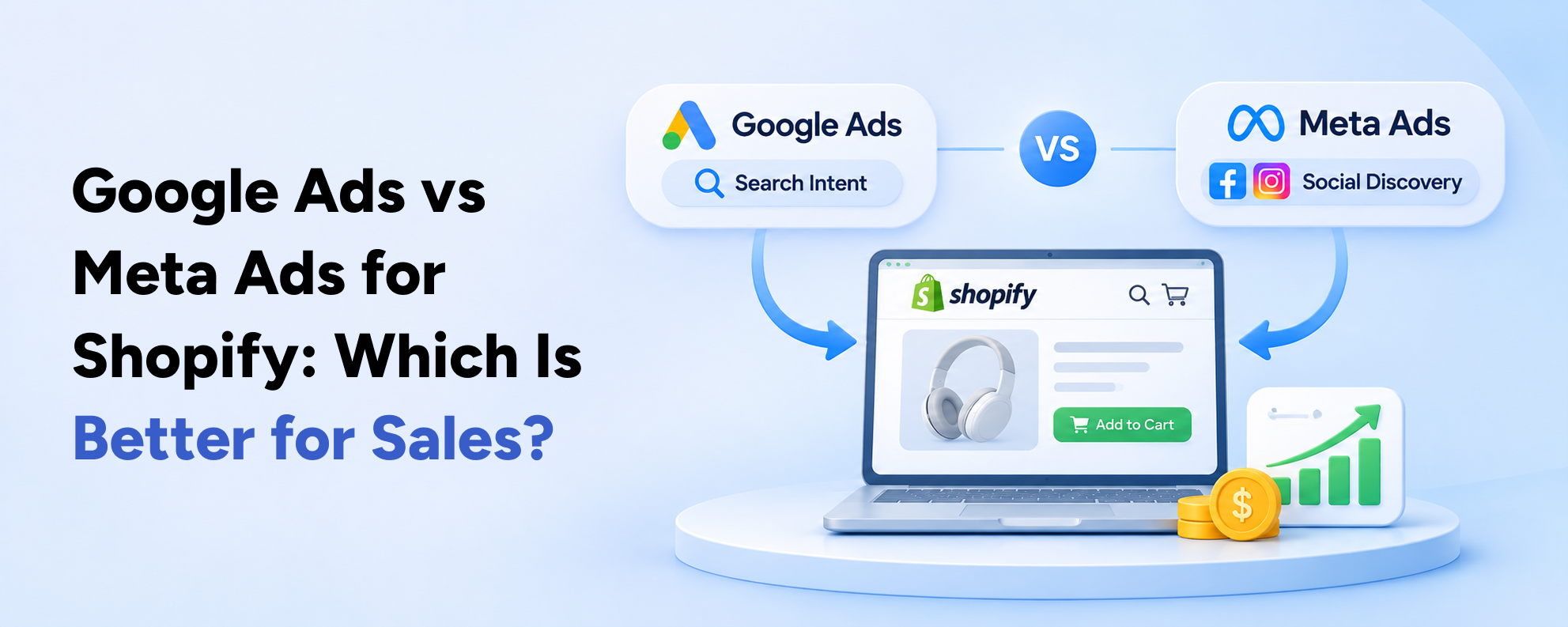
Both platforms can generate ecommerce sales, but they reach customers in different ways. Google Ads can connect your products with shoppers actively searching for something to buy, while Meta Ads can introduce your brand to people browsing Facebook and Instagram.
So, which platform should you choose?
Should you invest in Google Shopping campaigns to capture customers with purchasing intent? Or should you focus on Meta Ads to reach new audiences through engaging product images and videos?
The answer depends on your products, business model, advertising budget, competition, and customer buying behavior.
In this guide, we compare Google Ads vs Meta Ads for Shopify, explain their advantages and limitations, review 2026 advertising benchmarks, and show how to choose a strategy that supports profitable sales.
Quick Answer: Google Ads or Meta Ads for Shopify?
Google Ads is often the stronger starting point for Shopify stores selling products that customers actively search for, such as electronics, furniture, appliances, and specialized equipment.
Meta Ads can be more effective for introducing visually appealing, innovative, or lifestyle products that customers may discover through Facebook and Instagram.
However, neither platform is guaranteed to deliver more profitable sales.
Google Ads primarily helps businesses capture existing purchasing demand through Search and Shopping campaigns, while Meta Ads is particularly useful for generating demand through visual advertising, product demonstrations, and audience discovery.
The right decision ultimately depends on customer acquisition cost, contribution margin, and incremental revenue—not clicks or reported ROAS alone.
Understanding Google Ads and Meta Ads for Shopify
Before comparing performance, it helps to understand how each advertising platform works.
Although both platforms use automated bidding and audience signals, the situations in which customers encounter their advertisements are different.
What Is Google Ads for Shopify?
Google Ads allows Shopify businesses to promote products across Google's advertising network, including Google Search, Shopping placements, YouTube, and other supported surfaces.
For example, imagine a customer searching for:
“Buy waterproof hiking boots”
This search indicates that the customer may already be considering a purchase.
A relevant Google Shopping ad could display a product image, price, and retailer information directly in the shopping experience.
The customer can then visit the Shopify store, review the product, and complete an order.
According to Google's official Shopping Ads documentation, product advertisements can display important details such as photographs, prices, and merchant names before shoppers click.
This makes Google particularly useful when people already know what type of product they want.
Main Google Ads Campaign Types for Shopify
Shopify merchants can use several Google advertising formats.
- Search Ads: Text advertisements that appear for relevant search queries.
- Shopping Ads: Product-focused advertisements using information from Google Merchant Center.
- Performance Max: Automated campaigns that can promote products across multiple Google advertising channels.
- Demand Gen: Visual and video-focused campaigns designed to reach and engage audiences across eligible Google surfaces.
- Display and Remarketing Ads: Advertisements that can reach previous visitors or relevant audiences across supported placements.
Performance Max is particularly relevant to ecommerce because it can use Merchant Center product information and automated optimization.
However, businesses should not assume that every Google Ads placement targets someone actively searching. YouTube, Display, and Demand Gen campaigns can also support product discovery and awareness.
What Are Meta Ads for Shopify?
Meta Ads are paid advertisements distributed across Facebook, Instagram, Messenger, and other eligible Meta advertising placements.
Rather than relying primarily on keywords entered into a search engine, Meta uses audience signals, creative content, and campaign objectives to find potential customers.
For example, someone scrolling through Instagram may see a short video demonstrating a compact kitchen appliance.
Although that person was not actively searching for the product, the demonstration could generate enough interest to visit the Shopify store.
This is one of Meta's major strengths: introducing products to customers before they begin searching.
Main Meta Advertising Formats
Common formats for Shopify businesses include:
- Image Ads: Product photographs accompanied by persuasive messaging.
- Video Ads: Demonstrations, tutorials, and lifestyle-focused product promotions.
- Carousel Ads: Multiple images or products presented within one advertisement.
- Collection Ads: Shopping-focused experiences combining product catalogs with visual creative.
- Catalog Ads: Product advertisements generated from a connected catalog.
- Retargeting Ads: Campaigns designed to reconnect with relevant previous visitors or customers, subject to privacy settings.
Meta also offers AI-supported campaign features, including Advantage+ capabilities that can help automate audience discovery and campaign delivery.
The Facebook and Instagram by Meta integration allows eligible Shopify merchants to synchronize products with Meta catalogs.
Google Ads vs Meta Ads: Key Differences
The major difference between these platforms is how they connect customers with products. Google Search and Shopping advertising frequently responds to existing shopping interest.
Meta advertising often creates interest by presenting products to people who may not yet know they need them.
Google Ads vs Meta Ads Comparison Table
| Feature | Google Ads | Meta Ads |
|---|---|---|
| Primary Strength | Capturing existing demand | Creating demand and product discovery |
| Main Platforms | Google Search, Shopping, YouTube, Display | Facebook, Instagram, Messenger |
| Customer Intent | Often higher in Search and Shopping | Varies by audience and campaign |
| Targeting | Search queries, product feeds, audiences, AI signals | Audience signals, customer data, creative, AI optimization |
| Ad Formats | Text, product listings, images, video | Images, video, Reels, Stories, carousel, catalog |
| Product Discovery | Strong across Shopping, YouTube, and other placements | Strong through social content |
| Retargeting | Available | Available |
| Shopify Integration | Google & YouTube channel | Facebook & Instagram by Meta |
| Creative Requirements | Product feeds and relevant ad assets | Strong visual creative and regular testing |
| Main Limitation | Limited search demand or intense competition | Creative fatigue and uncertain immediate purchase intent |
| Sales Potential | Strong for relevant buying searches | Strong for compelling products and audience discovery |
Neither platform wins every category.
For example, Google may deliver efficient sales for a replacement appliance with existing search demand. Meanwhile, Meta may generate more new customers for an innovative product that people have never heard of.
The correct advertising strategy should reflect how customers discover, evaluate, and purchase your particular products.
Which Platform Generates More Shopify Sales?
When evaluating Google Ads vs Meta Ads for Shopify sales, it is important to distinguish between reported revenue, actual orders, and profitable customer acquisition.
A campaign may produce impressive traffic while generating very few purchases.
Similarly, a campaign with higher advertising costs may still be more profitable if it consistently attracts customers with larger orders.
Google Ads: Capturing Customers Ready to Buy
Google Search and Shopping advertisements can connect with customers who have already expressed purchasing interest.
For example:
“Buy ergonomic office chair online”
A customer performing this search may already understand their needs and be comparing available options.
If a Shopify store offers a relevant product at a competitive price, advertising can help it reach that customer during the buying process.
This makes Google Ads useful for businesses selling products with established market demand.
However, competition may increase advertising costs, particularly in categories with many similar retailers.
Meta Ads: Generating Demand Through Product Discovery
Meta Ads works differently.
A customer may have no immediate intention of purchasing a skincare product, clothing accessory, or home decoration item.
However, a compelling demonstration or lifestyle video could motivate that customer to explore the product.
This gives Meta advertising an important role in reaching audiences who are not yet actively shopping.
Creative quality becomes especially important.
Effective Meta advertisements often demonstrate the product's purpose, address customer objections, and communicate a clear reason to purchase.
Which Platform Converts Better?
Google Search and Shopping campaigns frequently attract visitors with stronger immediate purchase intent.
However, Meta campaigns can generate valuable new customers and contribute to purchases that occur later.
For example, a customer might:
- Discover a product through an Instagram advertisement.
- Visit the Shopify store but leave without purchasing.
- Search Google for the brand several days later.
- Click a Google advertisement and complete the order.
In this situation, Meta helped introduce the product, while Google helped capture the eventual purchase.
Looking only at the final advertising interaction could underestimate Meta's contribution.
Therefore, successful ecommerce marketing requires understanding the complete buying journey.
Google Ads vs Meta Ads Costs and ROAS in 2026
Advertising costs vary significantly depending on product categories, competition, targeting, market conditions, and campaign quality.
It is not accurate to say that Google Ads is always more expensive or Meta Ads is always cheaper.
The more useful comparison is how efficiently each platform generates profitable customers.
2026 Google Ads and Meta Ads Benchmarks
Ecommerce analytics provider Triple Whale published benchmark reports covering August 1, 2025, through July 31, 2026.
Its Google Ads benchmark report includes data from more than 21,000 brands, while its Meta Ads benchmark report includes more than 40,000 brands.
The reports provide the following overall median performance figures:
| Advertising Metric | Google Ads | Meta Ads |
|---|---|---|
| Return on Ad Spend (ROAS) | 3.27× | 1.88× |
| Conversion Rate | 3.11% | 1.53% |
| Cost Per Acquisition | $28.14 | $38.99 |
| Cost Per 1,000 Impressions | $15.35 | $15.06 |
| Click-Through Rate | 1.65% | 2.39% |
These figures represent different advertising datasets and campaign mixes. They are not guaranteed Shopify outcomes or a controlled head-to-head experiment.
What Do These Numbers Tell Us?
Google Ads recorded a higher median ROAS and conversion rate in these reports.
This is consistent with the advantage of reaching shoppers who already demonstrate purchasing interest.
However, that does not establish that Google is always more profitable.
Google's reported results can include branded searches and remarketing activity, where customers may already have intended to purchase.
Meta may contribute earlier in the customer journey by creating demand that later appears in Google search activity.
In fact, Triple Whale reports that Meta represented 66.88% of advertising spend among brands in its datasets, compared with 22.50% for Google.
This suggests that many participating ecommerce advertisers invest significantly in reaching audiences through Meta, despite Google's higher reported median ROAS.
The most useful benchmark is still your own business's customer acquisition cost, profit margin, and long-term customer value.
Why a Higher ROAS Does Not Always Mean Higher Profit
ROAS measures advertising revenue relative to advertising spend.
The formula is:
ROAS = Revenue Attributed to Ads ÷ Advertising Spend
Suppose a Shopify business spends $1,000 on Google Ads and records $3,500 in attributed revenue.
Its reported ROAS is 3.5×.
Another campaign spends $1,000 on Meta Ads and generates $2,400 in attributed revenue.
Its reported ROAS is 2.4×.
Google appears stronger in this example.
However, to evaluate profitability, the business must also consider product costs, fulfillment, payment fees, discounts, and returns.
If a store retains only 40% of sales revenue after these variable costs, it needs approximately 2.5× ROAS merely to cover advertising expenses, before fixed overhead.
Consequently, the Meta campaign in this hypothetical example would lose money on the initial purchases, while the Google campaign would generate a positive contribution.
However, the calculation may change when customer retention and repeat purchases are included.
How to Calculate Break-Even ROAS
A simplified formula is:
Break-Even ROAS = 1 ÷ Contribution Margin Before Advertising
For a business with a 40% contribution margin: 1 ÷ 0.40 = 2.5×.
This does not account for every business expense, but it provides a more meaningful starting point than chasing an arbitrary ROAS target.
Which Shopify Products Perform Better on Google Ads or Meta Ads?
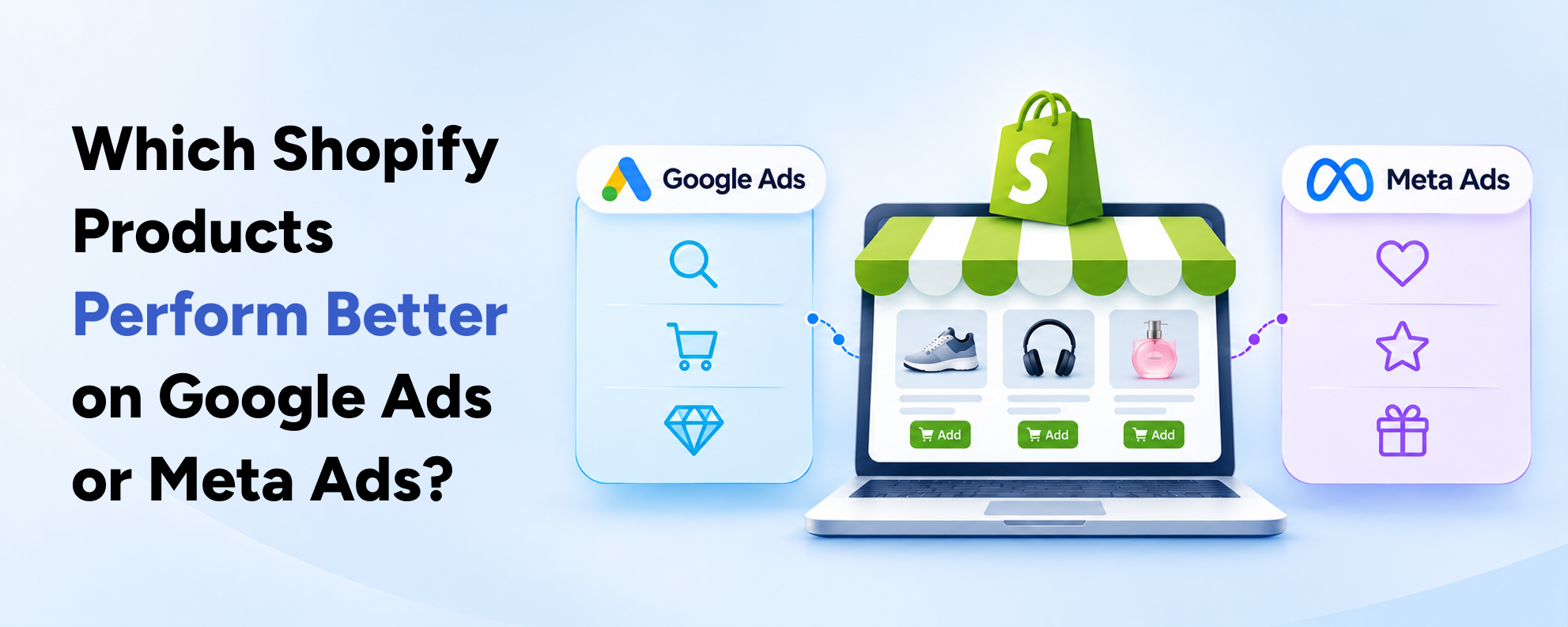
Different products naturally suit different advertising approaches.
Products That Often Suit Google Ads
Google Search and Shopping campaigns can work well for products with clear search demand.
Examples include:
- Electronics and Accessories.
- Home Appliances.
- Office Furniture.
- Automotive Accessories.
- Replacement Parts.
- Fitness Equipment.
- Specialized Tools and Equipment.
For these products, customers may already know the category, specifications, or features they need.
A search such as “buy 27 inch 4K monitor” signals more immediate shopping interest than a general social media impression.
Therefore, Google can provide a direct route to relevant product listings.
Products That Often Suit Meta Ads
Meta can work particularly well for products that benefit from visual demonstrations, emotional appeal, or lifestyle storytelling.
Examples include:
- Fashion and Apparel.
- Beauty and Skincare.
- Jewelry and Accessories.
- Home Decor.
- Innovative Gadgets.
- Gifts and Personalized Products.
- Lifestyle and Fitness Products.
For example, a Shopify brand selling an innovative cosmetic organizer might create a short Instagram Reel showing a cluttered dressing table transformed into an organized space.
The demonstration communicates the product's value before the customer searches for it.
However, visual products can also perform strongly on Google Shopping, and functional products can succeed on Meta through compelling demonstrations.
These categories are starting points, not strict rules.
When Should Shopify Businesses Choose Google Ads?
Google Ads may deserve priority when your products already have measurable search demand.
Your Customers Search for Specific Products
If customers regularly search for the types of products you sell, Google Search and Shopping campaigns can help capture that interest.
Keyword research and competitive analysis can reveal whether enough relevant searches exist to justify investment.
Your Product Catalog Is Well Structured
Google Shopping and Performance Max rely heavily on product information.
Accurate titles, descriptions, prices, availability, identifiers, and images help Google understand what you sell.
A poorly maintained Merchant Center feed can reduce campaign eligibility and performance.
The Google Merchant Center advertising guide explains how retailers connect product data to Shopping campaigns.
Your Business Needs to Reach High-Intent Buyers
Businesses seeking customers who are actively comparing products may benefit from non-branded search campaigns.
However, monitor branded and non-branded results separately so existing brand demand does not distort customer acquisition analysis.
You Have Competitive Product Pricing and Offers
Customers using Shopping ads can compare products, prices, and retailers.
Therefore, strong product availability, transparent delivery policies, and competitive offers can influence purchasing decisions.
Advertising alone cannot compensate for a weak or uncompetitive product proposition.
When Should Shopify Businesses Choose Meta Ads?
Meta Ads can be particularly valuable when your products need introduction, explanation, or emotional engagement.
You Are Launching a New Product
Innovative products may have limited existing search demand.
If potential customers do not know the product exists, they may not search for it.
Meta provides an opportunity to demonstrate the product and generate interest.
Your Products Benefit From Videos
Short demonstrations, customer experiences, product comparisons, and lifestyle videos can communicate benefits quickly.
However, creative assets should remain accurate and relevant to the actual product.
You Want to Reach New Audiences
Meta's campaign optimization can help identify potential buyers using available audience signals and advertising interactions.
This is valuable for brands that want to grow beyond an existing customer base.
You Have a Strong Product Story
Brands with distinctive positioning, design, or customer experiences can use visual campaigns to communicate what makes their products different.
For example, a sustainable accessories brand could explain its materials, product design, and intended use through a series of short advertisements.
An important principle comes from Nicole Silver, director of marketing at Superpower Social, quoted in Shopify's 2026 paid advertising guide:
“Understand how your audience thinks and what roles each channel plays in their lifestyle.”
Her advice highlights why advertising decisions should begin with customer behavior rather than platform popularity.
How to Use Google Ads and Meta Ads Together for Shopify Sales
For businesses with sufficient budget and conversion data, Google and Meta can complement each other.
Rather than competing for the same role, each platform can support a different part of the purchasing journey.
Stage 1: Introduce Products Through Meta Ads
Use engaging product videos, image advertisements, and demonstrations to reach potential customers.
The objective is to communicate the product's value and generate qualified interest.
For example, a brand selling ergonomic desk accessories could publish short videos demonstrating how its products improve everyday workspaces.
Stage 2: Capture Demand Through Google Ads
As customers become familiar with the product or start comparing available options, Google Search and Shopping campaigns can capture relevant searches.
A shopper might search for “ergonomic laptop stand” after watching a product demonstration on Instagram.
Google Ads can help the business appear during that research process.
Stage 3: Reconnect With Interested Visitors
Both advertising platforms offer remarketing capabilities.
For example, eligible visitors who viewed a product without purchasing may later encounter relevant advertisements.
Shopify explains how its Meta dynamic retargeting ads can use synced catalog information to promote products that visitors previously explored.
However, retargeting depends on available audience data, platform eligibility, and applicable privacy requirements.
Stage 4: Improve the Shopify Store Experience
Traffic acquisition is only part of the process.
Visitors must also find the Shopify store trustworthy, relevant, and easy to use.
Important conversion factors include:
- Clear Product Images and Descriptions.
- Easy Mobile Navigation.
- Transparent Shipping Information.
- Appropriate Payment Options.
- Customer Reviews and Trust Signals.
- A Smooth Checkout Experience.
- Relevant Product Recommendations.
At Basil Tech Solutions, Shopify development and digital marketing considerations can be approached together so that advertising traffic is supported by an effective storefront experience.
How Much Should You Spend on Google Ads vs Meta Ads?
There is no universal budget allocation that works for every Shopify business.
A business with strong search demand may benefit from investing more heavily in Google.
Meanwhile, a new visual product brand may need to establish demand through Meta before increasing search advertising.
Example Monthly Advertising Budget Allocations
The following are illustrative planning scenarios, not guaranteed optimal allocations.
| Business Situation | Monthly Ad Budget | Google Ads | Meta Ads |
|---|---|---|---|
| Established Search-Driven Store | $5,000 | 65% | 35% |
| New Lifestyle Product Brand | $5,000 | 35% | 65% |
| Growing Store With Balanced Demand | $8,000 | 50% | 50% |
The actual percentages should depend on profitability, search demand, creative quality, and available conversion data.
What If You Have a Small Advertising Budget?
If your Shopify store has approximately $1,000 to $1,500 per month available for paid advertising, beginning with one primary platform may be more practical than splitting the budget across several campaigns.
For example, a store selling specialized automotive accessories could begin with Google Shopping or tightly focused Search campaigns.
A store launching an unfamiliar visual product could begin with a concentrated Meta sales campaign.
Once the business has enough performance information, it can test the second channel.
How Long Should You Test Campaigns?
Allow enough time to collect meaningful conversion data.
For example, Google's Performance Max optimization guidance recommends running campaigns for at least six weeks to give automated systems time to gather performance information.
The appropriate testing period depends on campaign volume, budget, and the customer buying cycle.
Avoid making major decisions solely from a few days of results, particularly when conversion volumes are low.
Shopify Conversion Tracking: How to Measure Which Platform Drives Sales
Accurate conversion tracking is essential when comparing Google Ads and Meta Ads.
Without it, advertising platforms may receive incomplete or duplicate purchase data, making campaign optimization more difficult.
Set Up Google Ads Tracking on Shopify
Shopify's Google & YouTube sales channel can connect a store with Google Merchant Center, Google Ads, and Google Analytics 4.
A typical setup involves:
- Installing the Google & YouTube sales channel.
- Connecting the appropriate Google account.
- Linking Google Merchant Center when product feeds are needed.
- Connecting the Google Ads account.
- Configuring purchase conversion measurement.
- Checking event values and transaction identifiers.
- Testing a completed order.
Use the official Shopify Google & YouTube setup guide for current integration instructions.
Also, ensure that the store does not send the same purchase through multiple redundant integrations.
Set Up Meta Pixel and Conversions API
Meta provides browser-based and server-side conversion measurement options.
Shopify's Facebook and Instagram channel supports different data-sharing levels, including Standard, Enhanced, and Maximum.
Depending on the selected configuration, the integration can use the Meta pixel and Conversions API.
These tools can help transmit customer interaction and purchase information for advertising measurement.
However, businesses must manage customer consent, privacy requirements, and data-sharing preferences appropriately.
The Shopify Meta data-sharing documentation explains these settings.
Importantly, using browser and server-side tracking together does not automatically mean every event will be recorded correctly.
Check event deduplication, purchase values, and event delivery to avoid inaccurate reporting.
Track the Metrics That Actually Matter
Shopify businesses should measure more than impressions and clicks.
| Metric | What It Measures | Why It Matters |
|---|---|---|
| ROAS | Attributed revenue divided by ad spend | Shows reported revenue efficiency |
| Customer Acquisition Cost | Acquisition spend per new customer | Measures cost of growth |
| Conversion Rate | Purchases relative to eligible visits or clicks | Evaluates buying efficiency |
| Average Order Value | Revenue per order | Measures transaction value |
| Contribution Margin | Revenue left after variable costs | Helps evaluate profitability |
| New Customer Revenue | Revenue from first-time purchasers | Separates acquisition from repeat sales |
| Blended Revenue-to-Ad-Spend Ratio | Total store revenue divided by paid advertising spend | Provides a business-level efficiency view |
Why Google Ads and Meta Ads May Report Different Revenue
A customer can interact with advertisements on several platforms before purchasing.
Each platform uses its own attribution rules and available signals to assign credit.
As a result, Google and Meta may both claim a conversion associated with the same order.
That does not mean the Shopify store generated two separate purchases.
For more balanced analysis, compare advertising platform reports with Shopify order data and a consistently configured analytics system.
Shopify's marketing reporting documentation explains how marketing channels are identified in store reports.
Businesses conducting larger campaigns can also consider controlled incrementality tests to estimate how much additional revenue advertising actually creates.
Common Mistakes Shopify Stores Make With Google and Meta Ads
Advertising results often depend as much on implementation as platform selection.
Mistake 1: Comparing Only Cost Per Click
A cheaper click does not necessarily generate a cheaper customer.
One platform may produce inexpensive traffic that rarely purchases, while another generates fewer but more valuable visits.
Compare acquisition cost and contribution profit rather than clicks alone.
Mistake 2: Advertising Poorly Optimized Product Pages
If product pages have confusing information, weak images, unexpected shipping charges, or usability problems, advertising performance can suffer.
Before increasing budgets, review the shopping experience.
Mistake 3: Ignoring Product Feed Quality
Google Shopping campaigns depend on accurate product data.
Incorrect prices, unavailable inventory, missing identifiers, or unsuitable images can create eligibility and performance problems.
Meta catalog campaigns also depend on properly synchronized product information.
Mistake 4: Reusing the Same Creative Everywhere
An advertisement designed for a Google Search result may not communicate effectively in an Instagram Reel.
Each placement requires assets appropriate to its format and customer context.
Mistake 5: Overvaluing Retargeting Results
Retargeting campaigns may report strong ROAS because they reach people already familiar with the business.
However, some of those customers may have purchased without seeing another advertisement.
Evaluate prospecting and remarketing separately when possible.
Mistake 6: Ignoring New Customer Profitability
An established Shopify store may have strong reported sales from repeat buyers while struggling to attract profitable new customers.
Evaluate first-purchase economics and repeat purchase behavior instead of combining all revenue into one performance number.
Mistake 7: Scaling Before Tracking Is Reliable
Increasing advertising spend without validated conversion events can amplify reporting problems.
Test purchases, event values, and integrations before significantly expanding campaigns.
Practical Examples: Choosing Google Ads or Meta Ads for Shopify
The following hypothetical scenarios illustrate how product characteristics can affect advertising decisions.
Example 1: Shopify Store Selling Office Equipment
A business sells ergonomic chairs, standing desks, and monitor accessories.
Potential customers already search for products such as “adjustable standing desk” and “ergonomic office chair.”
Recommended Starting Strategy
Prioritize Google Search and Shopping campaigns targeting relevant product demand.
Support this approach with accurate Merchant Center feeds, competitive product descriptions, and well-structured Shopify collection pages.
Meta Ads could later introduce product demonstrations or reach additional audiences.
In this situation, Google is a reasonable starting point because customers already know what they want.
Example 2: Shopify Store Launching an Innovative Beauty Product
A skincare brand introduces a new product with an unusual application method.
Because customers are unfamiliar with the concept, few people search for its exact features.
Recommended Starting Strategy
Prioritize Meta video and image advertisements that demonstrate the product and explain its benefits.
Test different messaging approaches and monitor new customer acquisition costs.
As product awareness develops, Google Search and Shopping campaigns may help capture growing interest.
Here, Meta may contribute more to initial discovery, while Google supports later demand capture.
Example 3: Established Shopify Fashion Store
A fashion retailer already receives organic traffic, repeat purchases, and significant brand searches.
The business wants to expand into new customer segments.
Recommended Starting Strategy
Use Meta Ads to introduce collections to new audiences and test creative concepts.
Use Google Shopping and non-branded Search campaigns to capture category-level purchasing demand.
Track branded searches separately to avoid mistaking existing brand recognition for entirely new customer acquisition.
The combined strategy should focus on increasing total profitable orders rather than maximizing each platform's reported ROAS independently.
How Basil Tech Solutions Can Help Shopify Businesses Generate More Sales
Choosing between Google Ads and Meta Ads is only one part of building a profitable ecommerce marketing strategy.
A successful Shopify store needs a clear connection between advertising, product presentation, customer experience, and conversion measurement.
At Basil Tech Solutions, we bring Shopify development and digital marketing considerations together to support businesses looking to improve their ecommerce performance.
Shopify Store Development and Optimization
An effective storefront helps advertising visitors discover products, understand their value, and complete purchases.
This includes mobile usability, navigation, product information, and checkout experience.
Google Ads and Meta Ads Strategy
Advertising decisions should reflect search demand, audience behavior, product characteristics, and financial objectives.
A structured strategy identifies suitable campaign types and establishes clear measurement requirements before scaling investment.
Conversion Rate Optimization
Generating more traffic does not automatically produce more sales.
Improving product pages, customer journeys, and checkout usability can help Shopify businesses make more effective use of their existing traffic.
Ecommerce SEO and Long-Term Growth
Paid advertising can generate visibility quickly, while SEO helps build organic search presence over time.
These channels can support one another, particularly when businesses align product content, search intent, and landing page quality.
For additional information about Shopify development and ecommerce growth, explore the Basil Tech Solutions blog.
Ready to Improve Your Shopify Advertising Performance?
Whether you're launching your first advertising campaign or evaluating existing Google and Meta results, your marketing decisions should be guided by measurable business outcomes.
Connect with Basil Tech Solutions to discuss your Shopify store, advertising requirements, and conversion optimization opportunities.
Frequently Asked Questions
Is Google Ads Better Than Meta Ads for Shopify Sales?
Google Ads can be more effective when customers actively search for the products you sell, particularly through Search and Shopping campaigns. Meta Ads can perform well for visually appealing products, product discovery, and audience development. The better platform depends on customer acquisition costs, margins, and incremental sales.
Which Is Cheaper for Shopify: Google Ads or Meta Ads?
Neither platform is consistently cheaper. Advertising costs vary by audience, product category, competition, creative quality, and market. Meta may offer inexpensive reach in some situations, while Google can provide strong purchase intent. Compare cost per profitable customer rather than cost per click alone.
Can I Run Google Ads and Meta Ads Together on Shopify?
Yes. Shopify supports integrations with both Google and Meta. Businesses can use Google Search and Shopping campaigns alongside Meta image, video, and catalog advertisements. However, campaigns should have clear objectives, reliable tracking, and sufficient budgets to generate useful performance data.
What Is a Good ROAS for Shopify Advertising?
A good ROAS depends on your contribution margin, operating expenses, and customer lifetime value. For example, a store retaining 40% of revenue after variable costs needs approximately 2.5× ROAS to cover advertising spend before fixed overhead. Businesses with lower margins generally need higher ROAS to remain profitable.
Are Facebook and Instagram Ads Effective for Shopify?
Yes, Meta Ads can help Shopify brands introduce products, reach new audiences, and reconnect with interested shoppers. Their effectiveness depends heavily on product appeal, creative quality, targeting signals, customer experience, and conversion tracking.
Is Google Shopping Better Than Facebook Ads?
Google Shopping is particularly useful when people are already searching for products and comparing retailers. Facebook Ads can be valuable for introducing unfamiliar products and reaching customers through visual content. Neither format is universally superior; the decision should reflect the product and its buying journey.
How Much Should a New Shopify Store Spend on Advertising?
There is no fixed minimum budget that guarantees meaningful results. A new store should begin with an amount it can afford to test while collecting enough conversions to evaluate performance. Businesses with limited budgets may benefit from concentrating on one platform before expanding.
Do I Need Shopify Plus to Run Google Ads or Meta Ads?
No. Shopify Basic, Grow, Advanced, and Plus merchants can use eligible Google and Meta advertising integrations. Shopify Plus is not required for standard ecommerce advertising campaigns. The availability of specific features may depend on the merchant's country, store eligibility, and advertising account.
Can Meta Ads Generate Sales Without Google Ads?
Yes. A Shopify business can generate sales using Meta Ads alone if its products, creative strategy, pricing, and storefront experience support profitable conversions. However, businesses should monitor customer acquisition costs and consider whether Google could capture additional relevant demand.
Why Do Google Ads and Meta Ads Report Different Conversion Numbers?
Google and Meta use different attribution settings, customer signals, and reporting methodologies. They may also assign credit to the same order when a customer interacts with both platforms. Compare their reports with Shopify orders and consistent analytics data before evaluating true business performance.