
Table of Contents
Your Shopify store started with just a few essential apps. One for customer reviews, another for email marketing, and perhaps a third for product recommendations.
Then your business started growing.
You installed an upselling app, a wishlist app, a loyalty program, a shipping calculator, a chatbot, an inventory management tool, and several marketing integrations.
Before you realized it, your Shopify dashboard showed 50 installed apps.
But what happens when your Shopify store has 50 apps installed? Does it slow down your website, affect your Google rankings, increase expenses, or create problems with customer experience?
The answer is more complicated than simply counting applications.
Having too many Shopify apps can create performance, operational, and financial challenges. However, 50 installed apps do not necessarily mean your store will perform poorly. Some applications operate primarily in the background, while others load scripts, stylesheets, and interactive elements directly into your storefront.
The real issue is how those apps affect your website, whether their functionality overlaps, and how much value they provide.
According to Shopify's official web performance guidance, installed apps and third-party code are among the factors that merchants should evaluate when improving storefront performance.
In this article, we explain what happens when your Shopify store accumulates 50 apps, how app overload can affect speed and conversion rates, and how to identify unnecessary applications without damaging essential functionality.
Can a Shopify Store Have 50 Apps Installed?
Yes. A Shopify store can have 50 installed apps, and the number alone does not determine whether the website is slow, secure, or profitable.
Shopify apps extend ecommerce functionality by adding features such as product reviews, subscriptions, marketing automation, inventory synchronization, and customer support.
However, not every app works in the same way.
Some applications operate mainly within Shopify's administrative environment or communicate with external systems through APIs.
Others actively modify the customer-facing storefront.
Understanding this difference is essential.
Storefront Apps vs. Backend Apps
Consider two applications.
The first synchronizes inventory information between Shopify and an external warehouse management system.
The second displays an interactive popup, loads customer tracking scripts, and creates personalized product recommendations.
Both are installed Shopify apps. However, the second may introduce considerably more browser-side processing.
Similarly, a lightweight app using modern Shopify theme extensions may have a different performance impact from an older app injecting several third-party scripts into every page.
Therefore, counting installed apps is not an accurate substitute for measuring actual performance.
Does Shopify Recommend a Maximum Number of Apps?
Shopify's published performance guidance does not establish a universal number of installed apps that every merchant should stay below.
Instead, it recommends reviewing unnecessary apps and the performance impact of third-party code.
The important questions are:
- Does the app load JavaScript or CSS on the storefront?
- Is the feature actually being used?
- Does another application provide the same functionality?
- Can Shopify's existing features handle the requirement?
- Does the app improve customer experience or business operations?
- Is the subscription cost justified?
A store with 15 poorly optimized apps could experience greater problems than a store with 50 well-managed integrations.
The objective should be to maintain an efficient application ecosystem rather than pursue an arbitrary app count.
What Happens When You Install Too Many Shopify Apps?
Installing applications without an ongoing review process can create several challenges.
Here are 10 potential consequences Shopify merchants should understand.
1. Your Shopify Store May Load More Slowly
One of the most common concerns associated with Shopify app overload is slower website performance.
Many storefront applications introduce additional JavaScript, CSS, network requests, and third-party resources.
For example, a product page might load code for customer reviews, recommendations, chat support, subscriptions, and promotional popups.
Each feature can add work for the visitor's browser.
If several applications load large or render-blocking files, customers may have to wait longer before meaningful content appears.
Shopify's theme performance recommendations explain that excessive JavaScript can delay rendering and compete with the browser's ability to respond to user interactions.
However, the impact is not always proportional to the number of apps installed.
An application that processes orders in the background may have little direct effect on initial storefront rendering.
Example: A Product Page With Multiple Scripts
Imagine a product page containing:
- A reviews widget.
- A discount popup.
- A live chat application.
- A recently viewed products section.
- A personalized recommendation carousel.
- A countdown timer.
If every component loads immediately, the browser may need to download and execute substantial code before the customer begins interacting with the page.
A more efficient implementation might load nonessential features only when they are needed.
Consequently, customers could receive a more responsive shopping experience without requiring the business to abandon useful functionality.
2. Mobile Shopping Can Become Frustrating
Mobile visitors often have different device and network conditions from desktop users.
A resource-heavy Shopify store may appear acceptable on a powerful laptop but feel considerably slower on a budget smartphone.
For example, excessive JavaScript can delay responses when customers try to open a menu, select a product variant, or interact with a product recommendation widget.
Moreover, large popups and overlapping interface components can make a small screen difficult to navigate.
This matters because a customer should be able to browse products and reach checkout without unnecessary interruptions.
How to Check Mobile Performance
Test representative product, collection, and homepage URLs using Google PageSpeed Insights.
Pay attention to mobile measurements and actual user experience data where available.
You should also test your storefront on real mobile devices.
An application that looks useful on desktop may cause usability problems on mobile.
3. Google SEO Performance May Be Affected Indirectly
Can too many Shopify apps hurt SEO?
Potentially, yes. However, Google does not apply a known ranking penalty simply because a Shopify store has 50 installed applications.
The concern is the effect certain applications may have on page experience, technical accessibility, and website functionality.
For example, poorly implemented storefront scripts may delay important content or interfere with customer interactions.
These issues can affect Core Web Vitals.
According to Google Search Central, Core Web Vitals measure important aspects of real-world page experience, including loading performance, interactivity, and visual stability.
Google recommends achieving good results in these metrics.
Nevertheless, Core Web Vitals are not the only factors used in search ranking systems. Improving a performance score does not guarantee higher rankings.
An effective Shopify SEO strategy should combine useful content, relevant product information, technical accessibility, internal linking, and strong website performance.
4. Product Pages May Experience Layout Shifts

Have you ever opened an ecommerce product page and noticed the Add to Cart button move just as you were about to tap it?
This is an example of unexpected layout movement.
Shopify apps can contribute to this problem when they insert content after the original page layout has rendered.
Common examples include:
- Product review ratings.
- Payment installment messages.
- Shipping estimates.
- Promotional banners.
- Inventory notifications.
- Additional product recommendation sections.
When these elements appear without reserved space, nearby content may shift.
As a result, customers could accidentally click the wrong element or lose their place on the page.
Shopify's developer documentation recommends reserving space for app-injected content to reduce these issues.
A well-designed storefront should remain visually stable while important content loads.
5. Multiple Apps Can Create Conflicting Customer Experiences
Another potential issue is overlapping functionality.
Imagine a Shopify store using three different promotional applications.
One displays a welcome discount popup.
Another shows an exit-intent offer.
The third adds a countdown timer and a discount notification.
Individually, each feature may appear useful.
However, when all three operate together, customers might encounter repeated messages, competing offers, or confusing discount conditions.
Similar problems can occur with multiple wishlist apps, reviews widgets, or product recommendation tools.
This creates unnecessary visual complexity.
Instead of encouraging purchases, excessive promotional elements may distract visitors from the products they originally wanted to explore.
What Should Shopify Store Owners Do?
Review the customer journey from the homepage to checkout.
Identify applications that display similar content or compete for the same screen space.
Then determine whether one well-configured solution can replace several overlapping tools.
The goal is to create a consistent shopping experience rather than maximize the number of visible features.
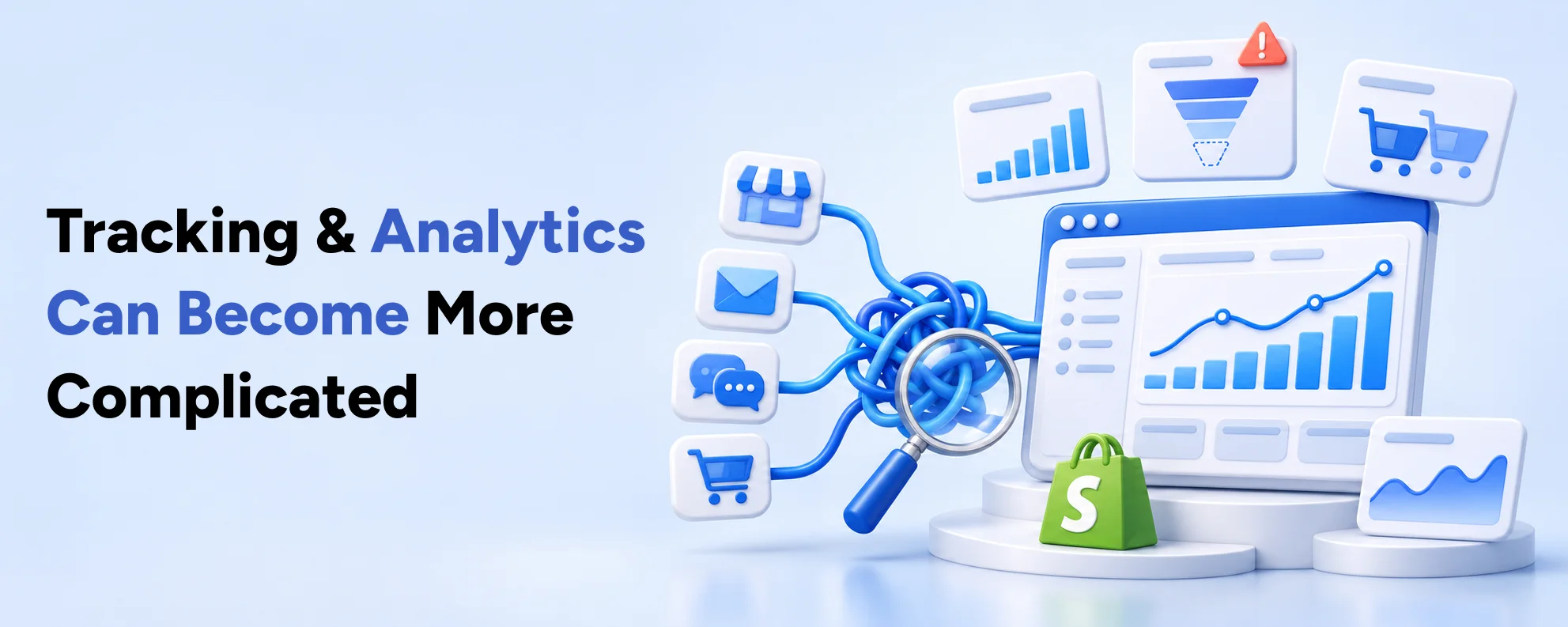
6. Tracking and Analytics Can Become More Complicated
Many Shopify merchants use analytics, advertising, customer behavior tracking, and conversion measurement tools.
However, installing multiple applications that perform similar tracking functions can create data-quality problems.
For example, a merchant might implement a marketing pixel through an official sales channel and then add another application that sends the same purchase event.
If both integrations report the same event without appropriate deduplication, conversions may be counted incorrectly in the affected reporting system.
This can lead to misleading campaign analysis.
Additionally, separate tracking applications may collect overlapping data or introduce unnecessary scripts.
Shopify's third-party script auditing guidance recommends identifying duplicate analytics and tracking integrations.
Review your measurement setup before adding another tracking app.
Where possible, use supported Shopify customer-event and web-pixel integrations with appropriate consent configurations.
7. Checkout and Shopping Cart Functionality May Conflict
Some applications affect shopping cart functionality, discounts, subscriptions, shipping, and checkout extensions.
These features are particularly important because they operate close to the point of purchase.
For example, a merchant may use separate apps for volume discounts, subscriptions, cart upselling, and shipping promotions.
If these applications rely on incompatible configurations or compete over pricing and cart behavior, customers may encounter unexpected results.
Potential problems include:
- Confusing discount eligibility.
- Incorrect promotional messaging.
- Cart functionality that does not behave as intended.
- Subscription options displaying incorrectly.
- Inconsistent shipping-related information.
However, conflicts are not inevitable. Shopify's supported application interfaces and extensions are designed to provide structured integration methods.
The most important practice is testing the combined shopping experience whenever a new app affects cart or checkout functionality.
Before launching major promotions, merchants should test relevant product combinations, discounts, payment methods, and customer scenarios.
8. Monthly Shopify App Expenses Can Increase Significantly
App costs are another reason to review your Shopify store regularly.
Some applications are free, while others charge monthly subscription fees, usage-based fees, or additional service charges.
A business can gradually accumulate several paid applications without realizing how much it spends on overlapping functionality.
Consider this hypothetical example:
A merchant installs 50 apps.
Of those, 20 have subscriptions averaging $20 per month. The remaining 30 are free or have no recurring fee.
The paid applications would cost approximately $400 each month, or $4,800 annually.
These figures are illustrative, not an estimate of typical Shopify app pricing.
Real costs depend on the applications, pricing tiers, usage, and external services.
Remember External Billing
Not every application-related expense necessarily appears on the main Shopify invoice.
According to Shopify's app billing documentation, some third-party providers bill merchants directly.
Therefore, merchants should review both Shopify billing and any external subscriptions.
An app that contributes meaningful revenue or operational savings may justify its cost. An unused app, however, adds expense without a corresponding benefit.
9. Data Privacy and Security Management Become More Complex

Shopify apps may request access to customer information, orders, products, inventory, or other store data.
These permissions are necessary for certain functions.
For example, a fulfillment integration may need order and shipping information to operate.
However, businesses should understand what data each application accesses.
Shopify displays app permission and privacy information during installation.
Merchants can also review installed app permissions from the Shopify admin.
With a larger collection of applications, maintaining visibility into data access becomes more important.
An extensive app stack does not automatically make a store insecure, but it can increase the number of external vendors and integrations that require oversight.
Best Practices for App Security
Review permissions and privacy policies before installing applications.
Remove apps that no longer serve a business purpose.
Limit staff permissions appropriately and review connections with external systems.
If your business operates internationally, consider applicable customer privacy requirements in the regions where you sell.
A well-managed Shopify store should maintain clear control over customer information and third-party access.
10. Maintenance and Troubleshooting Can Become More Difficult
As your app ecosystem expands, so does the number of integrations that may need troubleshooting.
A theme update, new feature, or app configuration change can affect another part of the storefront.
For example, a product recommendation widget may stop displaying correctly after significant theme changes.
Similarly, a custom script might interfere with an updated application.
These problems can become more difficult to diagnose when several tools modify the same areas of the website.
In addition, Shopify continues updating its platform and developer interfaces.
Merchants using older integrations should monitor relevant changes.
For example, Shopify's developer documentation states that new storefront ScriptTag creation and updates stopped on October 1, 2026, and existing storefront ScriptTag injection is scheduled to end on March 1, 2027.
The official Shopify storefront ScriptTag migration documentation explains the transition toward app embed blocks.
Therefore, stores with older integrations should check whether their app providers have prepared compatible updates.
How Shopify Apps Affect Core Web Vitals
Core Web Vitals are important measurements of the experience customers receive when visiting your Shopify store.
Three metrics deserve particular attention.
| Metric | What It Measures | Good Target | Possible App-Related Issue |
|---|---|---|---|
| Largest Contentful Paint (LCP) | Loading of the largest visible content element | 2.5 seconds or less | Render-blocking resources delaying product images or text |
| Interaction to Next Paint (INP) | Responsiveness to user interactions | 200 milliseconds or less | Excessive JavaScript delaying clicks and selections |
| Cumulative Layout Shift (CLS) | Unexpected visual movement | 0.1 or less | Widgets inserting content without reserved space |
Source: Google's Core Web Vitals documentation.
These targets are assessed using real-user measurements, typically at the 75th percentile.
Why App Count Is Not a Performance Metric
Imagine Store A has 12 installed apps, including several script-heavy widgets that load on every page.
Store B has 50 installed apps, but most handle administrative workflows, inventory synchronization, or other background operations.
Although Store B has significantly more installed apps, it could still deliver a better storefront experience.
The comparison illustrates why performance testing is more useful than counting applications.
Instead of asking how many apps are installed, merchants should investigate which applications are responsible for browser-side processing.
Where to Check Your Shopify Performance
Shopify provides its own web performance reporting.
You can find relevant reports through Shopify Admin > Analytics > Reports.
Search for web performance reports covering LCP, INP, and CLS.
The reports can help merchants evaluate performance across different pages and device types.
Shopify also provides historical context around changes such as app installations and theme updates.
However, changes may not appear immediately in the data.
Review Shopify's web performance reporting guide for the latest reporting functionality.
For deeper investigation, combine Shopify reports with Google PageSpeed Insights, Chrome DevTools, and relevant real-user data.
The Hidden Cost of Running 50 Shopify Apps
The true cost of an application is not limited to its subscription fee.
A business should also consider setup time, maintenance, third-party dependencies, performance impact, and the effort required to manage the application.
For example, an app might cost $15 per month but require recurring developer assistance whenever the theme changes.
Another tool might have a higher subscription price but replace three separate applications and reduce manual work.
Therefore, evaluating total value is more useful than comparing subscription prices alone.
Shopify App Cost Comparison
| Cost Category | Possible Impact | What to Review |
|---|---|---|
| Monthly subscriptions | Recurring operating expenses | Actual billing statements |
| Usage-based fees | Costs increase with activity | Usage limits and billing structure |
| External services | Additional provider expenses | Direct vendor invoices |
| Developer maintenance | Ongoing troubleshooting work | Support records and invoices |
| Duplicate functionality | Paying for similar features | App feature comparison |
| Performance overhead | More browser-side processing | Real performance measurements |
| Operational complexity | More systems to manage | Internal workflows and dependencies |
Before uninstalling a paid app, confirm whether it performs essential functions.
Otherwise, a rushed attempt to save subscription fees could disrupt revenue-generating activities.
Shopify App Overload: An Illustrative Example
Consider a hypothetical fashion ecommerce brand using Shopify.
The company started with a simple storefront and gradually installed 50 applications.
Its app collection now includes tools for email marketing, loyalty points, customer reviews, size guides, product recommendations, cart promotions, analytics, shipping, and inventory management.
The marketing team notices that mobile product pages have become less responsive.
Meanwhile, the finance team discovers several applications with overlapping subscription expenses.
The business decides to conduct a structured Shopify app audit.
Before the Audit
The brand identifies several potential issues:
- Two applications provide similar wishlist functionality.
- Multiple scripts handle overlapping tracking events.
- A promotional widget loads on pages where it is not used.
- An old app subscription is still active.
- Some applications are essential for inventory operations.
During the Audit
The development team documents every application and identifies its role.
It then tests storefront performance, reviews billing, examines third-party scripts, and checks which features customers actually use.
Rather than removing apps randomly, the team prioritizes obvious duplication and unnecessary resource loading.
Business-critical integrations remain untouched until suitable testing and replacement plans are available.
After the Audit
The desired outcome is a simpler application ecosystem, fewer unnecessary storefront scripts, improved cost visibility, and easier maintenance.
However, the actual results would need to be verified using performance measurements and business data.
This is an illustrative scenario, not a measured Basil Tech client case study.
The lesson is that app optimization should be driven by evidence rather than arbitrary removal targets.
How to Audit Your Shopify Apps: Step-by-Step Process
A Shopify app audit helps identify unnecessary costs, performance bottlenecks, duplicate features, and potentially outdated integrations.
The following process can be applied to both small and enterprise Shopify stores.
Step 1: Create an Inventory of Every Installed App
Open Shopify Admin > Settings > Apps.
Review all installed applications.
For each app, record its name, purpose, subscription cost, business owner, and important dependencies.
Also check whether it operates on the storefront, within checkout, or primarily in the backend.
A simple audit spreadsheet can make this process easier.
Step 2: Classify Apps by Business Importance
Organize applications into categories.
For example:
- Essential: Required for order processing, inventory, or critical business operations.
- Revenue-supporting: Contributes to merchandising, retention, or marketing.
- Optional: Provides useful but nonessential functionality.
- Duplicate: Overlaps with another solution.
- Unused: No longer serves a meaningful purpose.
Some applications may belong to more than one category.
The purpose is to support informed decisions, not automatically remove everything outside the essential category.
Step 3: Review Subscription and Usage Costs
Check Shopify billing details and external vendor invoices.
Identify apps with recurring fees that are no longer justified.
Where available, review usage statistics and measurable business outcomes.
For example, a subscription management app might be valuable if it supports an active recurring revenue program.
In contrast, a popup app that has not been used for months may be a candidate for removal.
Step 4: Test Your Store's Current Performance
Before making changes, establish a performance baseline.
Test the homepage, important collections, high-traffic product pages, and other relevant customer journeys.
Record Core Web Vitals, page responsiveness, and notable functionality issues.
Use a consistent testing approach so that later measurements remain comparable.
Because performance varies across devices and network conditions, avoid relying on a single Lighthouse score.
Step 5: Identify Heavy Storefront Scripts
Use Chrome DevTools or another performance analysis tool to review third-party resources.
Investigate:
- Large JavaScript files.
- Render-blocking CSS.
- Long main-thread tasks.
- Unnecessary requests.
- Duplicate tracking scripts.
- Third-party errors.
- Resources loaded on irrelevant pages.
Match these resources with the applications responsible for them.
Some scripts may come from theme customizations or tag managers rather than installed apps.
Therefore, verify the source before making changes.
Step 6: Review App Embeds and Theme Integrations
Shopify themes may integrate apps through app blocks, app embeds, or custom code.
Open the theme editor and examine the available app embeds and blocks.
Determine whether each active integration is required.
For example, a product reviews component may only need to appear on relevant product pages.
An application that unnecessarily loads its assets across the entire storefront may benefit from more targeted configuration.
Shopify's theme app extension documentation explains how app embeds can support more selective loading.
Step 7: Remove Unnecessary Apps Safely
Before uninstalling an application, identify any dependencies.
Check whether it controls subscription billing, inventory synchronization, discounts, fulfillment, or customer account features.
Export necessary information and review vendor-specific uninstall instructions.
Shopify warns that uninstalling an app does not always remove code previously added to a theme.
Therefore, additional cleanup may be required.
You can review the official Shopify app uninstall instructions before proceeding.
Step 8: Test Again After Changes
After removing or optimizing an application, test the affected functionality.
For example, if you remove a promotional app, confirm that pricing and discounts work correctly.
If you replace a reviews app, confirm that necessary review information has been transferred or preserved.
Then measure website performance again.
Compare the results with the original baseline and document any improvements or regressions.
For larger stores, make changes in controlled stages rather than removing multiple important applications simultaneously.
Which Shopify Apps Should You Keep, Replace, or Remove?
Not every app should be treated equally.
The following framework can help merchants prioritize decisions.
| App Type | Recommended Review | Typical Decision |
|---|---|---|
| Inventory Management | Critical operational dependencies | Keep if essential |
| Reviews | Customer trust and implementation quality | Keep or optimize |
| Email Marketing | Campaign value and overlap | Keep or consolidate |
| Product Recommendations | Relevance and storefront performance | Optimize or replace |
| Popup Applications | Engagement and competing overlays | Consolidate where possible |
| Analytics | Duplicate events and data consistency | Audit carefully |
| Old Theme Customizations | Compatibility and code residue | Review and clean up |
| Wishlist Applications | Actual customer usage | Keep or remove based on value |
| Shipping Integrations | Fulfillment dependencies | Keep if operationally required |
| Unused Promotional Apps | Current business value | Consider removal |
The correct decision depends on the business.
For example, a subscription-based beauty brand may consider subscription management essential.
A fashion retailer may prioritize size-guide functionality and product discovery.
An enterprise merchant could require multiple backend integrations that add little or no storefront rendering overhead.
How to Optimize Shopify Store Performance Without Losing Important Features
Reducing the number of apps is only one possible optimization method.
In many cases, merchants can preserve useful functionality while making the storefront more efficient.
Use Existing Shopify Features Where Appropriate
Before installing another app, check whether Shopify or your theme already supports the requirement.
Shopify provides functionality and first-party solutions for areas such as search and discovery, forms, automation, and product bundles.
For example, Shopify Search & Discovery can help merchants configure supported filters and product recommendations.
Meanwhile, Shopify Forms provides a first-party option for creating customer forms.
These tools may reduce the need for certain third-party applications.
However, first-party apps can still have performance implications, and replacing an application should always involve compatibility and feature testing.
Avoid Loading Every Feature on Every Page
Not every application needs to run across the entire website.
A size-chart feature may only be relevant to particular products.
A review widget may only be required on product pages.
A specialized recommendation component may only appear within selected collections.
Shopify developers can review whether scripts can load conditionally or after appropriate user interaction.
The official Shopify storefront performance guidance recommends using supported app extensions and limiting unnecessary asset loading.
Choose Apps That Follow Modern Shopify Development Practices
When evaluating applications, review their compatibility with your current Shopify theme and platform features.
Modern Shopify app blocks and app embeds provide structured integration methods.
However, using modern extensions does not automatically guarantee that an application is lightweight.
Developers still need to consider script size, rendering behavior, resource loading, and dependencies.
Optimize the Theme Alongside the Apps
Apps are not the only cause of a slow Shopify store.
Large images, excessive animations, third-party tags, and inefficient custom theme code may also affect performance.
Therefore, a complete optimization process should evaluate the storefront as a whole.
Businesses considering technical improvements can explore Shopify development and ecommerce optimization support from Basil Tech Solutions to assess how theme architecture, custom functionality, and app integrations fit together.
Establish an App Approval Process
One of the best ways to prevent future app overload is to introduce a simple approval process.
Before installing a new application, ask whether its functionality is necessary, whether an existing tool provides the same feature, and whether the expected value justifies the cost.
Also document who is responsible for managing the app.
For growing Shopify businesses, a quarterly app review can help prevent forgotten subscriptions and unnecessary integrations from accumulating.
How Many Shopify Apps Should Your Store Have?
There is no ideal app count that applies to every Shopify business.
A small store may function effectively with only a handful of applications.
A larger merchant may require numerous tools for inventory, fulfillment, subscriptions, customer service, international selling, analytics, and other operations.
The important distinction is between installing applications that support clear business requirements and accumulating tools without a management strategy.
A useful approach is to evaluate every application using three questions.
Does the App Provide Meaningful Value?
Determine whether the application supports revenue, customer experience, compliance, or operational efficiency.
Is the App Efficiently Implemented?
Review its actual impact on storefront performance and the systems it depends on.
Is the App Still Necessary?
Business requirements change.
An application installed during a previous marketing campaign may no longer serve a purpose.
Likewise, features previously available only through third-party apps may now have suitable first-party alternatives.
The healthiest Shopify app ecosystem is not necessarily the smallest.
It is the one in which every application has a clear purpose, appropriate implementation, and justified cost.
Frequently Asked Questions
Do too many Shopify apps slow down your store?
They can. Applications that load heavy JavaScript, CSS, or third-party resources may reduce storefront performance. However, not every installed app affects page speed. Apps working primarily in the backend may have minimal direct impact on customer-facing page rendering. Measure the actual resource usage before deciding which applications to remove.
Is having 50 Shopify apps too many?
Not necessarily. A store with 50 well-managed applications may perform better than one with fewer but poorly optimized integrations. Review each app's purpose, cost, performance impact, permissions, and maintenance requirements. There is no universal number that automatically makes a Shopify app ecosystem excessive.
Can Shopify apps affect SEO rankings?
Yes, indirectly. Some apps may contribute to slow loading, layout instability, and responsiveness issues. These can affect Core Web Vitals and customer experience. However, Google does not have a known ranking penalty based solely on installed app count. Content quality, relevance, technical accessibility, and other ranking factors remain important.
Will deleting Shopify apps improve page speed?
It may, particularly when an app loads unnecessary storefront resources. However, removing an app that operates only in the backend may have little effect on page speed. In addition, some uninstalled applications leave theme code behind. Conduct a performance audit before and after removal to measure the impact.
How do I know which Shopify app is slowing down my website?
Start with Shopify's web performance reports and Google PageSpeed Insights. Then use Chrome DevTools to inspect third-party scripts, network requests, and long-running JavaScript tasks. Identify which resources belong to installed apps and test suspected integrations carefully. Avoid assuming that the largest subscription or newest app is responsible.
Does uninstalling a Shopify app remove all its code?
Not always. Shopify explains that some applications add code to themes that is not automatically removed during uninstallation. Review the app developer's instructions, create a theme backup, and verify the storefront after removal. Be particularly careful with older applications or integrations involving manual theme edits.
Can multiple Shopify apps cause checkout problems?
They can create conflicts or unexpected behavior when they interact with cart, discount, subscription, shipping, or checkout functionality. However, supported Shopify extensions are designed for structured integration. Test the complete purchase process whenever changing an application that influences orders or payments.
Are free Shopify apps better for store performance?
Not necessarily. Price does not determine performance quality. A free app can load substantial frontend resources, while a paid app may be efficiently implemented. Conversely, some paid apps provide important functionality that justifies their cost. Evaluate actual performance, business value, permissions, and maintenance requirements.
How often should I audit my Shopify apps?
A quarterly review is a practical starting point for many ecommerce businesses. Additionally, review your app stack before major sales campaigns, theme redesigns, migrations, or significant Shopify platform changes. High-traffic or complex stores may need more frequent technical monitoring.
Can a Shopify developer reduce app overload without removing important features?
Yes. An experienced Shopify developer can audit existing integrations, identify duplicate functionality, optimize theme code, improve resource loading, and assess suitable alternatives. However, custom development is not always preferable. The right solution depends on feature requirements, maintenance costs, and the benefits of using existing Shopify functionality.